
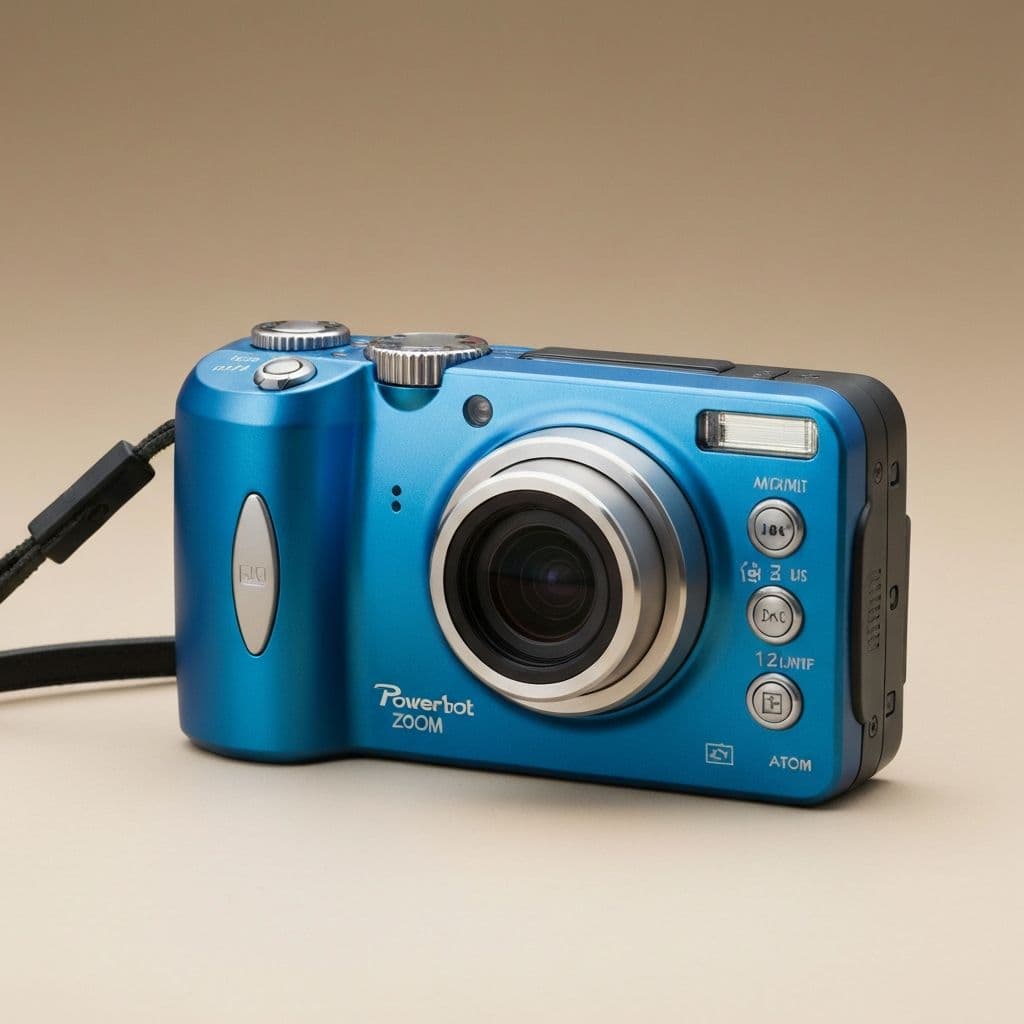
The short version: choose a Canon PowerShot if you want warm, flattering color and the cheapest, easiest ownership experience — they take standard SD cards, and the A series even runs on AA batteries. Choose a Sony Cyber-shot if you're drawn to sleeker industrial design, Carl Zeiss-branded lenses, and a slightly cooler, crisper rendering — and you don't mind buying a Memory Stick. Neither choice is wrong; they're the Coke and Pepsi of the Y2K era, and both produce the look people are chasing.
The color question
This is the real difference, and it's a matter of taste. Canon's CCD-era JPEG engine leans warm: golden skin tones, rich reds, a gentle glow under direct flash that flatters people. It's the classic 'house party 2005' look. Sony runs cooler and a bit more neutral, with punchy blues and strong micro-contrast from the Zeiss-branded glass — photos feel a touch more 'produced,' in a good way.
Both are unmistakably CCD images: 3 to 8 megapixels, visible grain, colors that pop without a filter. If you mostly photograph friends indoors with flash, Canon's warmth usually wins. If you shoot daylight, architecture, or want files that edit neutrally, Sony has the edge.
The Canon lineup: A series and SD (ELPH) series
The PowerShot A series (A520, A540, A630 and so on) is the practical classic — chunkier bodies with real handgrips, optical viewfinders, and AA batteries you can buy anywhere on earth. Many offer aperture- and shutter-priority modes, which makes them quietly great learning cameras.
The SD series, sold as the Digital ELPH, is the style icon: little boxes of brushed metal — SD600, SD750, SD1000 — that slip into any pocket. They use compact proprietary lithium-ion batteries and, like nearly all Canons of the era, standard SD cards. Note the era's card limit: most pre-2007 models read SD only up to 2GB, not SDHC, so pair them with a 1–2GB card.
The Sony lineup: P, W, and T series
The Cyber-shot P series (DSC-P100, P200) is the definitive silver Y2K brick — fast, solid, and beautifully made. The W series that followed is the enthusiast's pick: bright Zeiss lenses, manual exposure options, and on many models an optical viewfinder that Canon's ELPHs were already starting to drop.
The T series is Sony's flex: impossibly slim slabs like the DSC-T1 and T9 with a sliding front cover and an internal folded 'periscope' lens, so nothing extends when you shoot. Nothing Canon made looks like a T series. The trade-offs across all Sonys: Memory Stick (usually PRO Duo with an adapter) costs a bit more than SD secondhand, and Sony's InfoLithium batteries — clever in that they report remaining minutes — are proprietary, though replacements remain available.
Practical ownership, twenty years on
Availability and price favor Canon: PowerShots were bestsellers and survive in huge numbers, and SD cards plus AA compatibility (on the A series) make them the lowest-friction vintage cameras you can own. Sony bodies tend to age gracefully thanks to their metal builds, but the ecosystem — Memory Stick, proprietary chargers — asks a little more of you up front.
Reliability is more about the individual camera than the brand at this point. Either can arrive from an online auction with a jammed lens or a tired battery. That's why every PowerShot and Cyber-shot we sell at Measure Joy passes a 15-point inspection and ships with a working battery, the correct card guidance, and a 90-day warranty — the brand rivalry is fun, but a tested camera beats an untested one every time.
The verdict
Buy the Canon PowerShot if you want warmth, simplicity, and the easiest accessories. Buy the Sony Cyber-shot if design and optics are what pull you, or if the T series' sliding cover has already stolen your heart — you'll know if it has. And if you're still torn, go by feel: pick the one you'll actually carry, because the best Y2K camera is the one in your pocket at the party. Both lines are usually in stock in our shop, tested and ready to shoot.
Find your Y2K camera.
Every camera passes our 15-point inspection and ships with a working battery and a 90-day warranty.
Shop tested Y2K cameras