
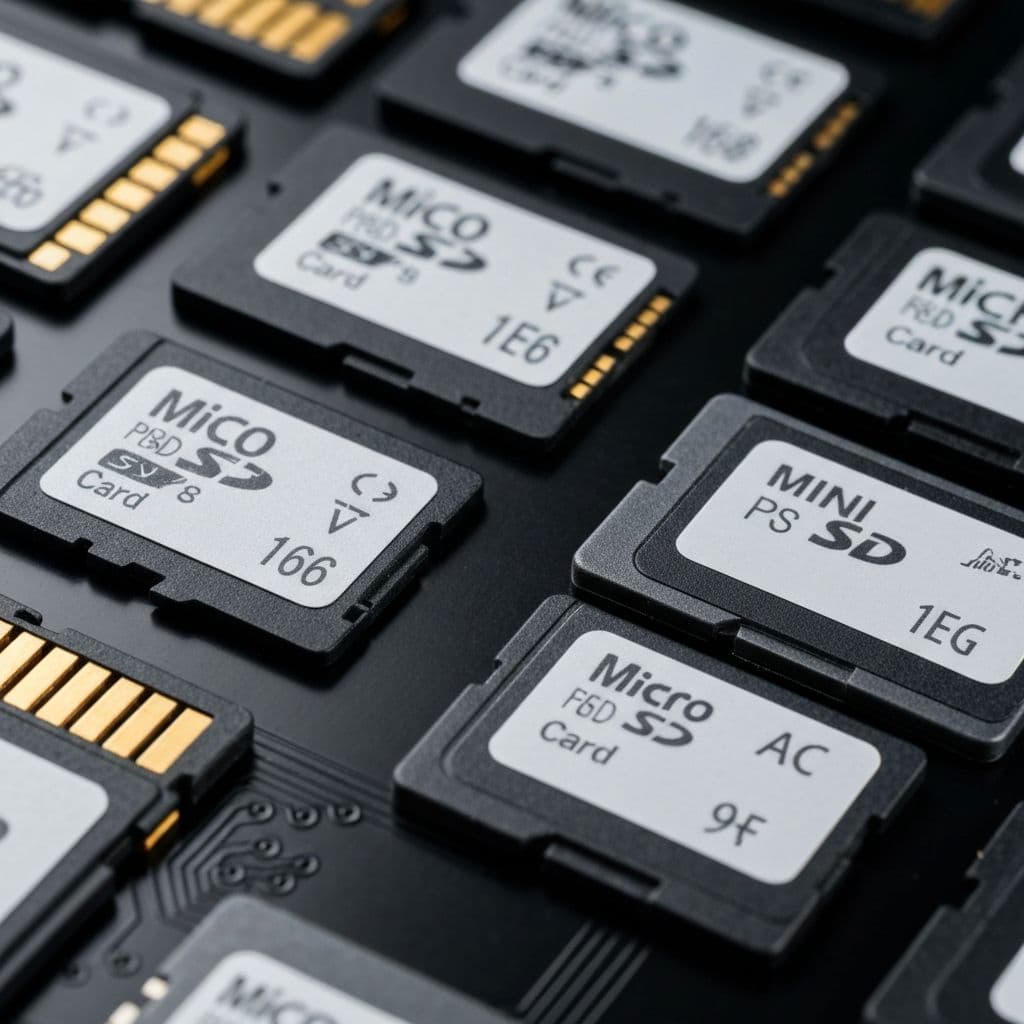
Quick answer: check your camera's brand. Canon, Nikon, Kodak, and Panasonic compacts almost all take SD cards (2GB or smaller for most pre-2007 models — not SDHC). Sony Cyber-shots take Memory Stick, usually Memory Stick PRO Duo with an adapter. Olympus and Fujifilm compacts take xD-Picture Cards. Get the right format and a USB card reader, and you're set.
SD: the format that won
Secure Digital launched in 1999 and became the default for most of the industry. The crucial thing to know for Y2K cameras is the capacity ceiling: original SD tops out at 2GB, and cameras made before roughly 2006–2007 generally can't read SDHC cards at all — an SDHC card will simply show a card error. Stick to 1GB or 2GB cards for older models; at 5 megapixels, a 2GB card holds well over 800 photos, so you won't feel cramped.
Good news: 1–2GB SD cards are still manufactured and cheap, and they work in modern card readers. We stock tested ones in our shop alongside the cameras that use them.
Memory Stick: Sony's own path
Sony introduced Memory Stick in 1998 and used it across Cyber-shot cameras, Handycams, and even the PSP. The original full-size stick maxes out at 128MB; Memory Stick PRO raised the ceiling, and the smaller Memory Stick PRO Duo (widely available up to 2–4GB and beyond) became the common form. Many full-size-slot cameras accept a Duo card in a simple sleeve adapter.
One caveat: older Cyber-shots that predate the PRO spec can't use PRO cards, so very early models are limited to the small original sticks. If you own a mid-2000s Cyber-shot, a PRO Duo plus adapter is the practical choice, and modern multi-card readers still read them.
xD-Picture Card: the Olympus and Fujifilm club
The xD-Picture Card arrived in 2002 as a joint Olympus–Fujifilm format — tiny, capable, and used by almost nobody else. Cards came in the original type plus later Type M and Type H revisions; most cameras handle all of them, but a few early bodies are picky, so check your manual if a card acts up. Capacities run from 16MB to 2GB.
xD cards stopped being manufactured years ago, so they cost more per gigabyte secondhand than SD. They're not rare, just less common — budget an extra few dollars, and consider picking up two so you always have a spare.
CompactFlash and the rest
CompactFlash, the chunky 1994-era format, shows up in earlier and higher-end cameras — early Canon PowerShots, prosumer Nikons, and most DSLRs of the era. It's robust and still easy to buy. You may also run into MMC (MultiMediaCard), a thinner card that works in most SD slots, and SmartMedia in late-'90s cameras, which is genuinely hard to source now.
Getting photos onto your phone or computer
Skip the original USB cables and drivers — a modern multi-format card reader (USB-A or USB-C) reads SD, Memory Stick Duo, and often xD directly, and works with phones as well as laptops. Format cards in the camera rather than on your computer, and you'll avoid most file-system weirdness.
Every camera we sell is tested with its correct card format as part of our 15-point inspection, and we'll always tell you exactly which card your model needs — no guessing at checkout.
Find your Y2K camera.
Every camera passes our 15-point inspection and ships with a working battery and a 90-day warranty.
Shop tested Y2K cameras