
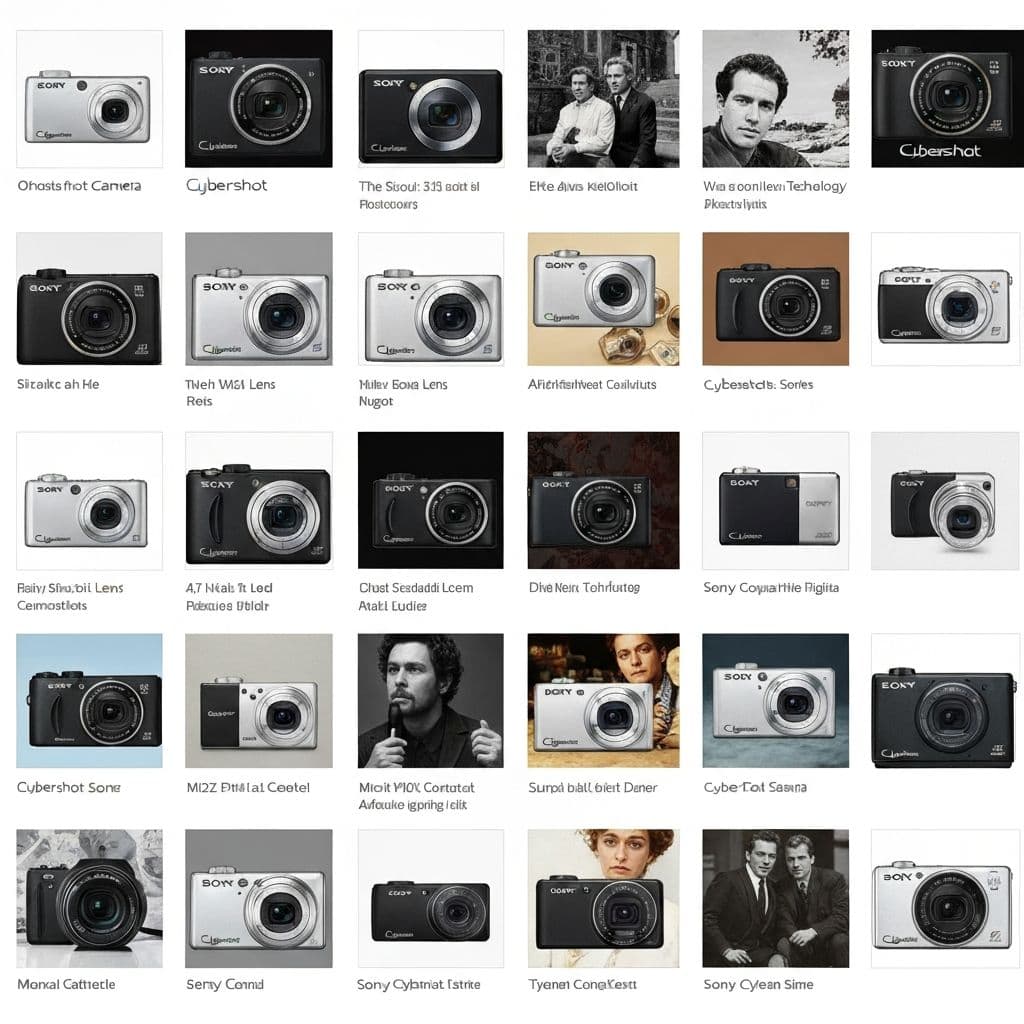
Sony's Cyber-shot line, launched in 1996 with the DSC-F1, is one of the longest-running names in digital photography — and the models from roughly 2000 to 2007 are the reason 'Y2K digicam' became an aesthetic. Sleek metal bodies, Carl Zeiss-branded lenses, and Sony's signature cool-toned CCD color made Cyber-shots the design icons of the era.
1996–1999: the experimental years
The original DSC-F1 was a strange, wonderful object: a 0.3-megapixel camera with a lens that rotated 180 degrees, aimed at early internet users more than photographers. Sony iterated quickly, and in 1999 the DSC-F505 marked a turning point — a large Carl Zeiss Vario-Sonnar zoom bolted to a small body, signaling that Sony intended to compete on optics, not just electronics.
Equally important was 1998's introduction of the Memory Stick, Sony's proprietary storage format. It locked Cyber-shot owners into Sony's ecosystem — a mild annoyance then, a collecting quirk now — but it also meant your camera, camcorder, and later your PSP could share cards.
2000–2004: the P series and the pocket revolution
The DSC-P1, released in 2000, was among the smallest 3-megapixel cameras in the world and defined the compact 'silver brick' shape the P series carried for years. Models like the DSC-P100 and DSC-P200 refined the formula: real Zeiss glass, fast startup, InfoLithium batteries that reported remaining minutes, and that unmistakable early-2000s industrial design.
Then came the T series. The 2003 DSC-T1 was genuinely radical — a slab barely thicker than a deck of cards, with a sliding front cover and a folded 'periscope' lens that zoomed internally, so nothing protruded when you shot. With its large LCD and jewelry-like build, the T series became the fashion camera of the mid-2000s, the one that appeared in music videos and handbags alike.
2005–2008: the W series sweet spot
For photographers rather than fashionistas, the W series — starting with cameras like the DSC-W1 and running through the W5, W7, and beyond — is arguably the best of Y2K-era Sony. These compacts paired 5-to-8-megapixel CCDs with bright Zeiss lenses, manual exposure options, and, on many models, a small optical viewfinder, a feature already vanishing from compacts by then. They're durable, plentiful, and produce lovely files.
It's also the era when Sony's ergonomics matured: menus got faster, startup times dropped under two seconds, and the AA-powered entry models meant you could keep a W-series alive with corner-store batteries on a road trip. If someone asks us for 'the Cyber-shot to actually shoot with,' this is the series we point to.
Why they hold up
Cyber-shots of this era have a particular rendering — slightly cooler and more neutral than Canon's warmth, with crisp micro-contrast from the Zeiss-branded optics. The build quality was real: solid metal shells that survive twenty years in a drawer surprisingly well. The main things to check on any used Cyber-shot are the battery (InfoLithium packs age, though replacements exist), the Memory Stick situation, and the LCD, which was ahead of its time and correspondingly precious.
We handle those checks for you — every Cyber-shot we sell passes our 15-point inspection and ships with a working battery, the correct Memory Stick guidance, and a 90-day warranty. If this history made you want one, see what's in stock; the P and W series in particular tend not to sit around long.
Find your Y2K camera.
Every camera passes our 15-point inspection and ships with a working battery and a 90-day warranty.
Shop tested Y2K cameras